


How to Choose a Panasonic Air Conditioner by Room Size
When choosing an air conditioner, room area is only the starting point. Required cooling capacity is also affected by ceiling height, window size, sun exposure, floor level, the number of occupants, and heat-producing appliances. This guide explains which Panasonic air conditioner is suitable for a bedroom, living room, kitchen-living space, apartment, or office.
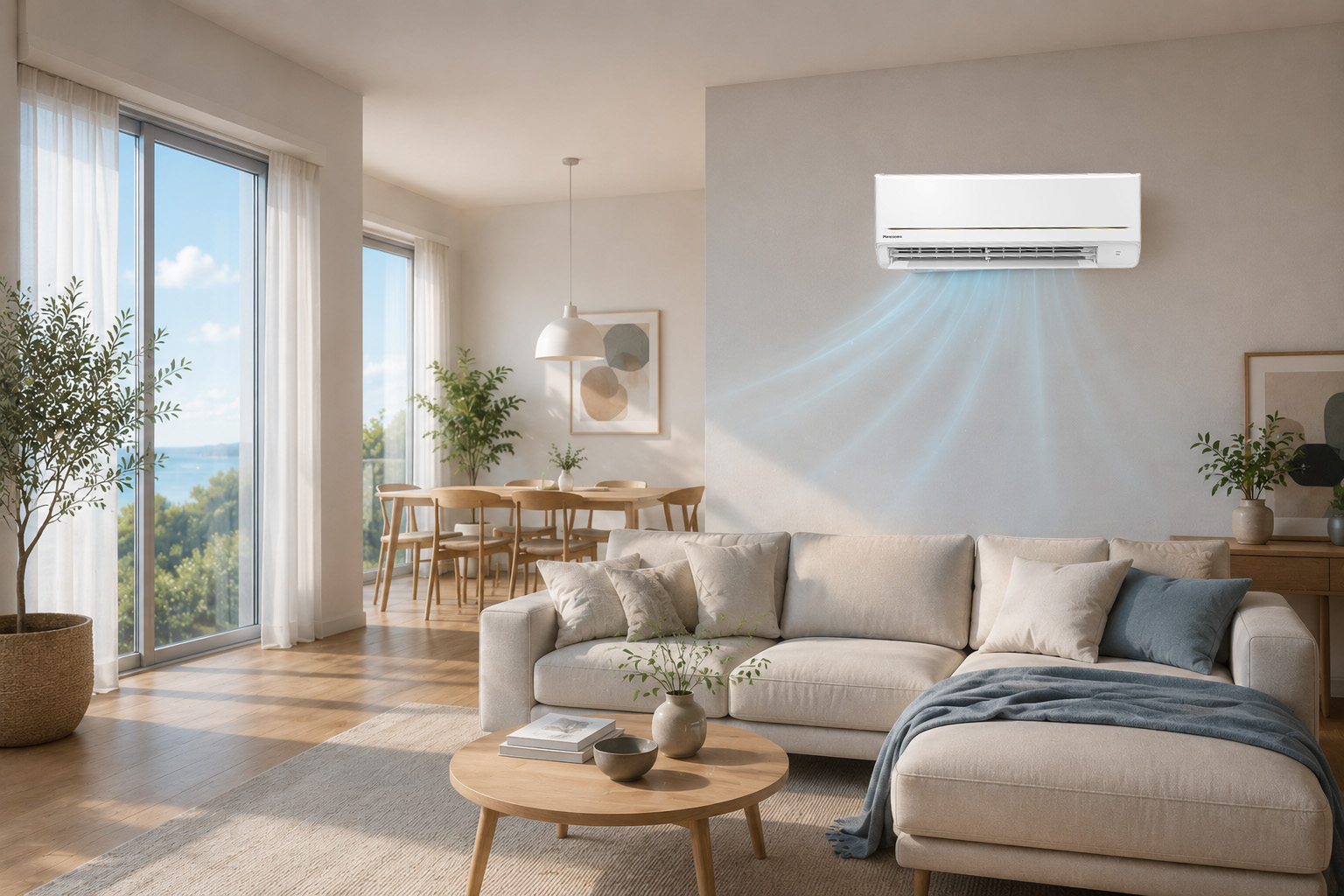
Quick answer: what air conditioner size does your room need?
For a standard room with a ceiling height of up to 2.7–3 metres, a useful starting point is about 1 kW of cooling capacity for every 10 m² of floor area.
- up to 20 m² — about 2.0 kW;
- up to 25 m² — about 2.5 kW;
- up to 35 m² — about 3.5 kW;
- up to 42–50 m² — about 4.2–5.0 kW;
- up to 60–75 m² — about 6.0–7.1 kW.
This is a preliminary estimate. Sunny rooms, open-plan kitchens, panoramic glazing, and high ceilings usually require additional capacity.
How to calculate air conditioner capacity by room area
Cooling capacity shows how much heat the system can remove from a room. It should not be confused with electrical power consumption: an air conditioner can deliver several kilowatts of cooling while consuming significantly less electrical power.
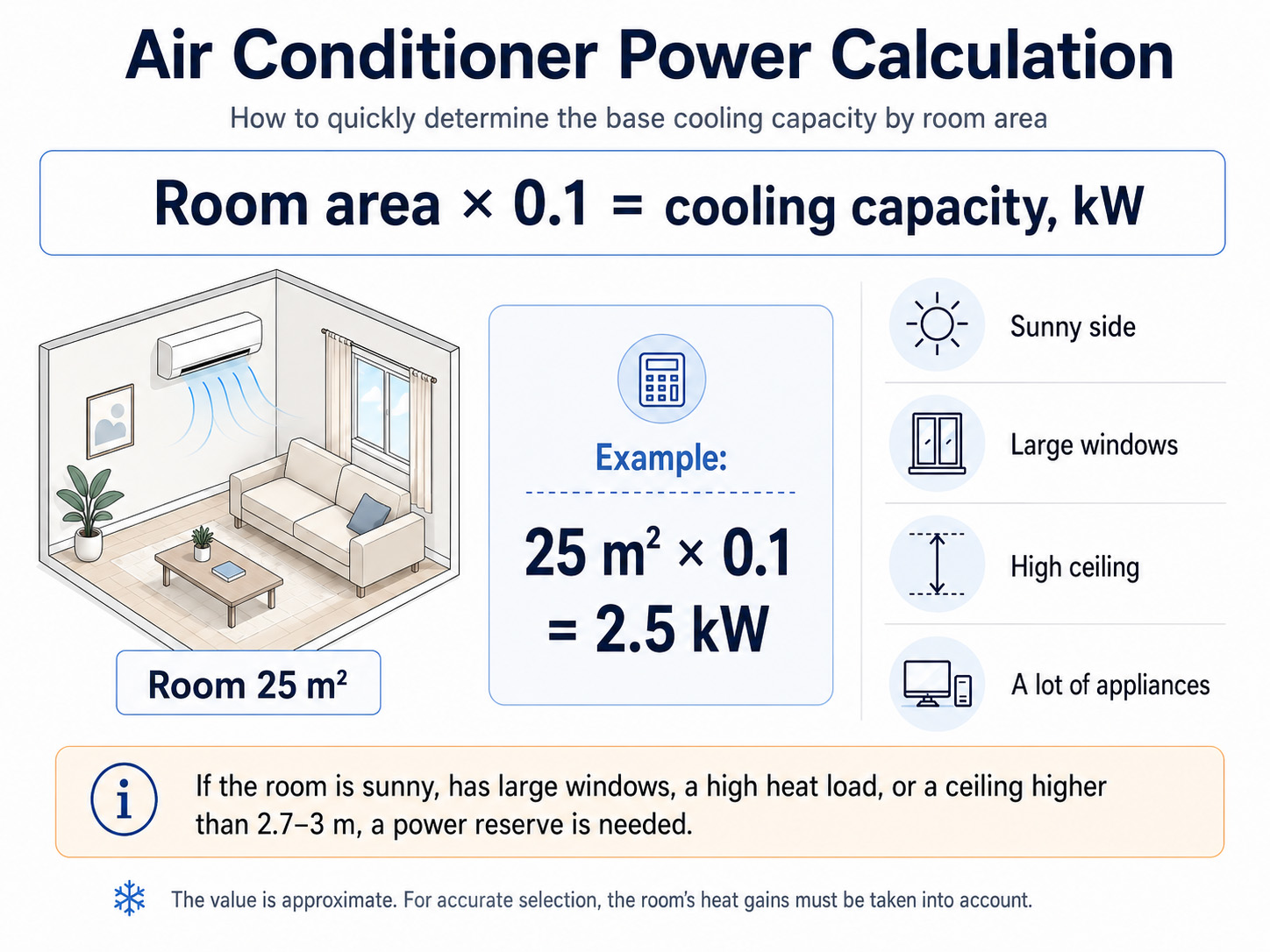
For a quick preliminary calculation, multiply the room area by 0.1:
Room area × 0.1 = approximate cooling capacity in kW
For example, a 25 m² room requires approximately 2.5 kW under standard conditions:
25 × 0.1 = 2.5 kW
This method is suitable for an initial estimate in a standard residential room. If the space receives strong sunlight or contains additional heat sources, the result must be adjusted.
Air conditioner selection table by room area
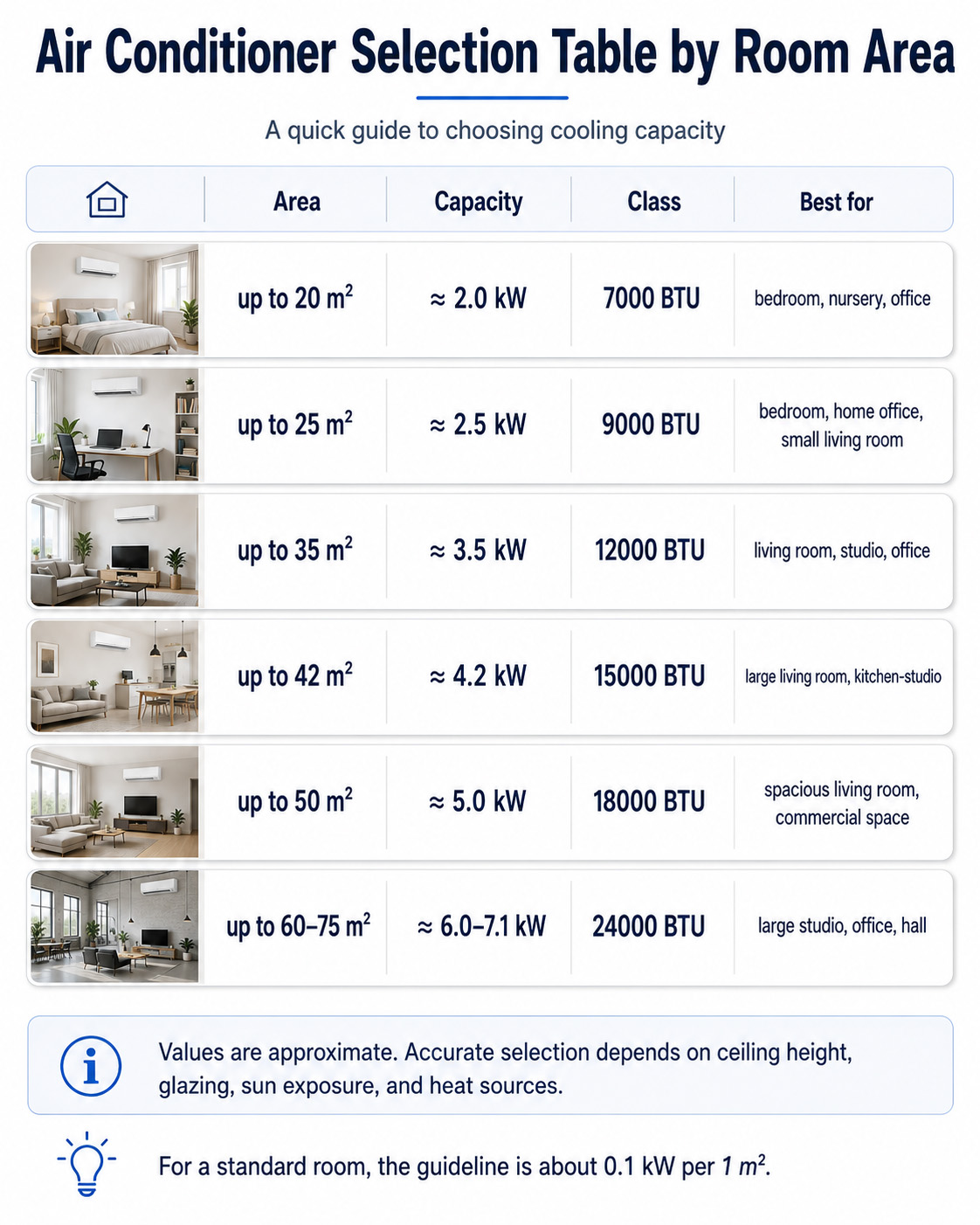
The table below provides a quick guide to selecting a suitable capacity class. The values apply to standard conditions and should be used as a starting point before a more detailed assessment.
Open the table in text format
| Room area | Cooling capacity | Class | Best suited for |
|---|---|---|---|
| up to 20 m² | about 2.0 kW | 7000 BTU | bedroom, nursery, home office |
| up to 25 m² | about 2.5 kW | 9000 BTU | bedroom, home office, small living room |
| up to 35 m² | about 3.5 kW | 12000 BTU | living room, studio, office |
| up to 42 m² | about 4.2 kW | 15000 BTU | large living room, kitchen-studio |
| up to 50 m² | about 5.0 kW | 18000 BTU | spacious living room, commercial space |
| up to 60–75 m² | about 6.0–7.1 kW | 24000 BTU | large studio, office, hall |
Important: room-area ratings are approximate. Accurate selection should also consider ceiling height, glazing, sun exposure, room layout, and internal heat sources.
When does an air conditioner need extra capacity?
A model selected strictly by floor area may not always provide sufficient cooling. Additional capacity is required when the room gains more heat than a standard residential space.
Sunny orientation and large windows
South- and west-facing windows can significantly increase indoor heat during the afternoon. Panoramic glazing also raises the cooling load. In such cases, a reserve of around 10–20% may be appropriate.
Top floor
If the apartment is directly beneath a poorly insulated roof or technical floor, the ceiling can become an additional heat source during summer.
High ceilings
Standard area-based guidance assumes a ceiling height of roughly 2.7–3 metres. At 3.2–4 metres, the volume of air increases substantially, so floor area alone is no longer sufficient.
Kitchen or open-plan kitchen-living room
Cooking appliances, ovens, refrigerators, kettles, and other equipment produce heat. An open-plan kitchen-living room normally requires more capacity than a bedroom of the same size.
Occupants and electronics
Computers, televisions, gaming systems, lighting equipment, and people all increase the heat load. This is especially important in offices and commercial spaces.
Practical advice: if your calculation falls between two capacity classes, do not automatically choose the larger model. It is better to assess the layout and heat gains with a Panashop specialist.
Why an oversized air conditioner is not always better
Buying a system with excessive capacity does not automatically improve comfort. The unit should match the actual cooling load of the room.
- higher equipment cost;
- an unnecessarily strong stream of cold air;
- uneven cooling in a small room;
- less effective humidity control;
- larger indoor and outdoor units.
Panasonic inverter air conditioners can modulate their output, but selecting the correct capacity class remains important.
Which Panasonic air conditioner should you choose for different rooms?
Bedroom of 15–20 m²
For a small bedroom, quiet operation is as important as capacity. A unit in the 2.0–2.5 kW class is usually sufficient. Check the minimum noise level, night mode, and airflow direction.
Room of 20–25 m²
A 9000 BTU model is one of the most versatile choices for a bedroom, home office, or small living room. Strong sunlight or extensive computer equipment may increase the required capacity.
Living room of 30–35 m²
A room of about 35 m² normally requires approximately 3.5 kW or 12000 BTU. Also consider glazing, adjoining open spaces, and where the airflow will be directed.
Open-plan kitchen-living room of 35–42 m²
An open-plan kitchen has a higher heat load than a standard room. A 4.2 kW class or the next size above the standard 35 m² model may be appropriate.
Room of about 50 m²
A large living room, studio, office, or commercial space of about 50 m² usually requires an 18000 BTU system.
Room of 60–75 m²
Large studios, offices, and halls may require 24000 BTU systems. In complex spaces, room shape and airflow distribution are especially important.
Which Panasonic air conditioner series should you choose?
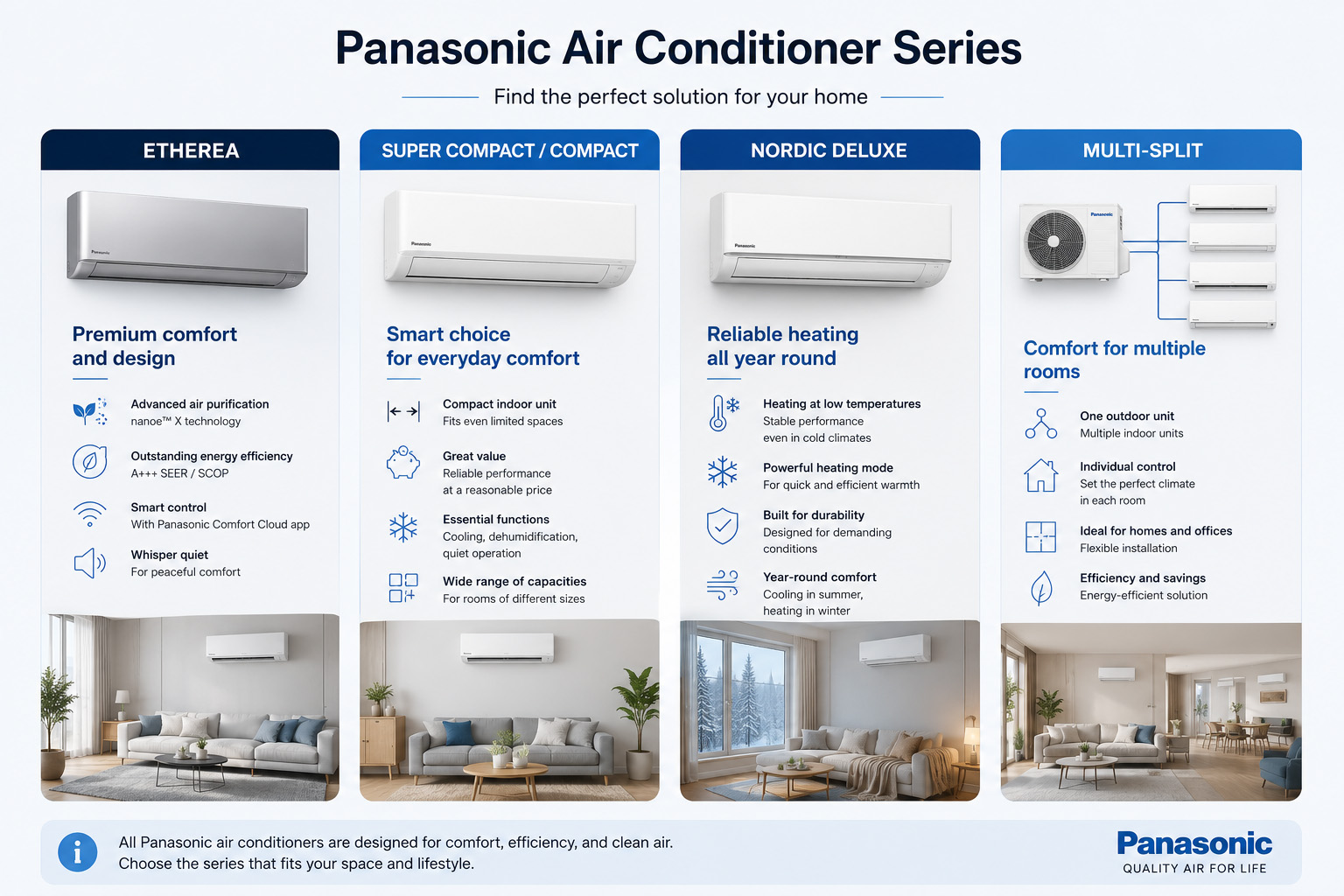
Once the required capacity has been established, you can compare Panasonic series by design, air purification, heating performance, connectivity, and installation configuration.
Panasonic Etherea
Etherea is suitable for buyers who prioritise high energy efficiency, premium design, advanced air purification, refined airflow control, and smartphone operation.
View Panasonic Etherea air conditioners
Panasonic Super Compact and Compact Inverter
Compact series are a practical choice where indoor-unit dimensions, essential comfort functions, and a balanced price-to-performance ratio are important.
View compact Panasonic air conditioners
Panasonic Nordic Deluxe
Nordic Deluxe is intended for users who plan to use the system for both summer cooling and active heating during cold weather.
View Panasonic Nordic Deluxe air conditioners
Panasonic Multi-Split
A multi-split system connects several indoor units to one outdoor unit. It is suitable for multiple separate rooms when installing several outdoor units is undesirable or impossible.
Popular Panasonic air conditioners by room size
The following models illustrate several common capacity classes. Check current availability and request an accurate calculation before ordering.
For rooms up to 20 m²
Panasonic Super Compact Inverter CS-PZ20WKD/CU-PZ20WKD
A compact solution for a small bedroom, nursery, or home office.
For rooms up to 25 m²
Panasonic Super Compact Inverter CS-PZ25WKD/CU-PZ25WKD
A versatile capacity class for a bedroom, office, or small living room.
For rooms up to 35 m²
Panasonic Nordic Deluxe CS-HZ35XKE/CU-HZ35XKE
A solution for cooling and active heating in colder conditions.
For rooms around 50 m²
Panasonic Etherea CS-Z50ZKEW/CU-Z50ZKE
A high-capacity option for a large living room, studio, or office.
What should you consider besides room area?
Noise level
For bedrooms, nurseries, and home offices, the minimum indoor-unit noise level may be more important than maximum output.
Energy efficiency
The longer and more frequently the system operates, the more important seasonal efficiency ratings become.
Heating performance
Do not look only for the presence of a heating mode. Check the minimum permitted outdoor temperature for the specific model.
Air purification
Additional purification technologies can improve indoor comfort, although an air conditioner does not replace ventilation or a dedicated air purifier in every situation.
Wi-Fi and remote control
Wi-Fi makes it possible to start cooling or heating in advance and manage the system from a smartphone.
Indoor-unit dimensions
Check the available wall space and leave the required service and installation clearances.
Airflow direction
Avoid directing cold air straight at a bed, sofa, desk, or dining area.
Can one air conditioner cool an entire apartment?
One indoor unit is most effective in the room where it is installed. Some cool air may move through open doors, but one unit generally cannot maintain an even temperature across several separate rooms.
For multiple rooms, consider separate split systems or a Panasonic multi-split configuration.
Common mistakes when choosing an air conditioner
- Using the total apartment area. Select capacity for the specific room or open zone being conditioned.
- Ignoring sun exposure. Two rooms of the same size can have very different cooling loads.
- Not allowing extra capacity for a kitchen. Cooking and appliances increase heat gain.
- Choosing the largest model “just in case”. More capacity does not always mean more comfort.
- Ignoring installation position. Poor placement can create uncomfortable drafts and uneven cooling.
- Assuming every model can heat at any outdoor temperature. The operating range varies by series and model.
- Choosing only by price. Compare noise, efficiency, functions, warranty, and service support.
How to choose a Panasonic air conditioner with Panashop
For an initial recommendation, provide the room area and ceiling height, window dimensions, sun orientation, floor level, number of occupants, main appliances, heating requirements, and preferred indoor-unit location.
Need help choosing?
Panashop specialists can calculate the required capacity, compare current Panasonic models, and recommend a system for your room area, layout, and operating conditions.
Open the catalogue Request a consultationFrequently asked questions
What air conditioner capacity is needed for a 20 m² room?
A standard 20 m² room usually requires around 2.0 kW of cooling capacity. Strong sun exposure, large windows, or high ceilings may require the next capacity class.
What air conditioner should I choose for a 25 m² room?
A 25 m² room normally requires approximately 2.5 kW or 9000 BTU, depending on glazing, sun exposure, ceiling height, and internal heat sources.
Which Panasonic air conditioner is suitable for 35 m²?
For around 35 m², a typical starting point is 3.5 kW or 12000 BTU. Suitable options may be available in the Etherea, Compact, and Nordic Deluxe ranges.
Should I choose an air conditioner with extra capacity?
A moderate reserve may be required for sunny rooms, top floors, large windows, high ceilings, open-plan kitchens, or rooms with substantial electronic equipment.
Can one air conditioner cool two rooms?
Cool air may partially move through an open doorway, but one indoor unit usually cannot maintain an even temperature in two separate rooms.
Can I choose a more powerful air conditioner?
Yes, when additional capacity is justified by a heat-load calculation. Selecting a substantially oversized unit without a clear reason is not recommended.